
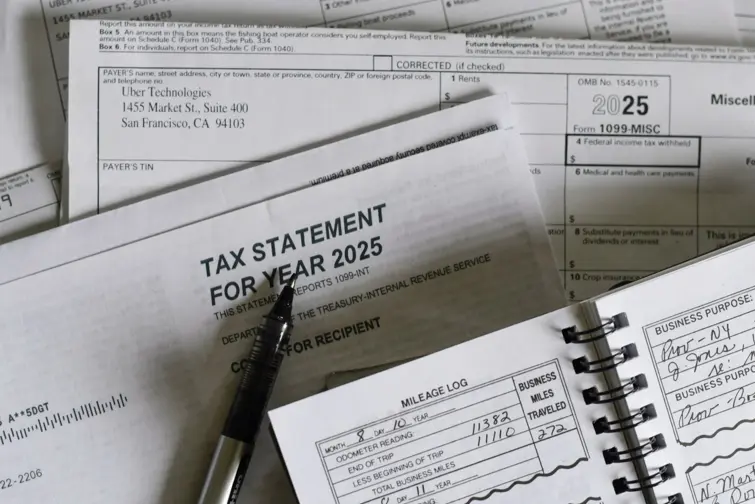
Tax-Deductible Expenses for Self-Employed Workers in Quebec: The Complete List
Vehicle, tools, home office, GST/QST: the complete list of tax-deductible expenses for self-employed contractors in Quebec, based on Revenu Québec's rules.
 The L'app du travailleur team
What "tax-deductible" actually means
You don't pay tax on what you invoice; you pay tax on your net income: what's left after your business expenses are subtracted from your revenue. Every legitimate expense you forget to deduct is tax and Quebec Pension Plan (QPP) contributions you're paying for nothing.
Revenu Québec's general rule is simple: an expense is deductible if it was incurred to earn business income, is reasonable given the circumstances, and you can back it up with a receipt (invoice, receipt, statement). No proof, no deduction if you get audited.
Deductible expense vs. recoverable tax: two different mechanisms
Don't mix these up:
- A deductible expense reduces your net income, and therefore your income tax and QPP contributions.
- The tax paid on that expense (GST 5% + QST 9.975%) is a separate mechanism: if you're registered for the taxes, you recover it separately through input tax credits (ITCs) and input tax refunds (ITRs), as explained in our guide to calculating GST and QST.
In practice: you deduct the pre-tax amount of the expense in your net income calculation, and recover the tax paid on it separately.
Vehicle expenses: the most misunderstood deduction
This is where most self-employed workers get it wrong. There is no flat per-kilometre rate you can simply apply: that rate (updated yearly by the Canada Revenue Agency) is for an employer reimbursing an employee, not for a self-employed person deducting their own vehicle costs.
The method Revenu Québec requires (detailed in guide IN-155) works differently:
- Add up all your vehicle costs for the year: fuel, maintenance, insurance, registration, financing or lease payments, depreciation.
- Calculate your business-use proportion: kilometres driven for work ÷ total kilometres driven during the year.
- Apply that proportion to your total vehicle costs.
A mileage logbook isn't optional. Without a detailed logbook (date, starting and ending points, purpose, kilometres driven), Revenu Québec can simply deny your entire deduction on audit, even if the expense was real.
The trip between your home and your first job site of the day is generally considered personal travel, not a business expense, unless your home is your main place of business.
Tools and equipment: two categories to know
The tax treatment depends on the cost of each tool, assessed individually, not by total invoice.
| Cost of the tool | Class | Treatment |
|---|---|---|
| Under $500 | Class 12 | 100% deductible in the year of purchase |
| $500 and over | Class 8 | Depreciated at 20%/year (declining balance), with the half-year rule applying in year one |
In practice, a $350 drill is fully deductible this year. A $1,200 table saw is depreciated over several years: roughly $120 in capital cost allowance (CCA) the first year (10%, due to the half-year rule), then 20% of the remaining balance each following year.
A deduction that does not apply to you
You may have heard of the tradesperson's tools deduction (up to $1,000, federal and Quebec combined). This measure is for salaried employees whose employer requires them to supply their own tools; it's claimed on an employment expenses form, not on a self-employed return.
As a self-employed worker, you're not subject to that $1,000 cap: you deduct 100% of your tool costs as a business expense or through CCA, per the table above. That's generally more favourable, but be careful not to confuse the two mechanisms if you come across articles aimed at employees.
Home office
If you prepare quotes, invoices, and job tracking from home, part of your housing costs may be deductible, but only if the space meets one of two Revenu Québec criteria:
- it's your main place of business, or
- you use it regularly and continuously to meet clients.
The space must also be used exclusively for your business (a shared kitchen table doesn't count). The deductible proportion is usually based on the area of the space relative to your home, adjusted for time of use if the room also serves another purpose.
Eligible costs on a prorated basis: rent or mortgage interest, electricity and heating, home insurance, property taxes, maintenance. If you repaint only the office, that expense is 100% deductible, not just prorated.
Meals and entertainment
A meal with a client or subcontractor to discuss a contract is deductible at 50% of the reasonable amount, taxes included. Your own lunch eaten alone, even on a job site far from home, generally remains a personal expense; the deduction applies to meals with a clear business purpose (client, supplier, partner).
Cell phone, internet, software, insurance, and professional dues
These expenses all follow the same principle: you deduct the proportion of use genuinely tied to your business, reasonably and with support.
- Cell phone and internet: business-use proportion, ideally backed by a detailed bill or your own usage log.
- Business software and subscriptions (invoicing, accounting, plans): 100% deductible if used strictly for business.
- Professional liability insurance: 100% deductible.
- RBQ licence, CCQ dues, professional order or association fees: 100% deductible when required to practise your trade.
The recap table
| Expense | What you deduct | Proof to keep |
|---|---|---|
| Vehicle | Total costs × business-use % | Detailed mileage logbook |
| Tools under $500 | 100% in the year of purchase | Receipt |
| Tools $500 and over | 20%/year, declining balance | Receipt, CCA tracking |
| Home office | % of area (and time, if shared) | Area calculation, housing bills |
| Business meals | 50% of the reasonable amount | Receipt + client name/purpose |
| Cell phone, internet | Business-use % | Billing statement |
| Insurance, RBQ, CCQ, dues | 100% | Payment receipt |
Common mistakes to avoid
Deducting a vehicle with no logbook. This is the costliest mistake on audit: without a logbook, the deduction can be denied entirely, not just reduced.
Mixing up deductible expenses and recoverable tax. These are two separate calculations (see above); conflating them throws off both your net income and your tax remittances.
Capitalizing a small tool "to be safe." A $300 tool is fully deductible this year; depreciating it over several years by mistake just delays your deduction for no reason.
Tossing small receipts. A $15 hardware store receipt counts just as much as a $3,000 equipment invoice; Revenu Québec doesn't waive the requirement for supporting documents based on the amount.
Keep your records
Revenu Québec requires you to keep supporting documents (invoices, receipts, mileage logbook) for at least six years after the end of the tax year in question. On audit, missing proof usually means a denied deduction, even if the expense was legitimate.
This isn't a substitute for tax advice
The rules above reflect the general principles set by Revenu Québec and the Canada Revenue Agency, but your situation may have its own particularities (business structure, type of contracts, province of residence). For an optimized, error-free return, an accountant or tax specialist remains one of the best investments you can make in your business.
What we can do for you, though: keep every invoice you issue, your GST/QST numbers, and your full revenue history organized in one place in L'app du travailleur, ready to export for your accountant when it's time to file.
More from the blog

Invoice Template for Self-Employed Contractors in Quebec
A free Excel invoice template and what a Quebec invoice must include: GST/QST, NEQ, RBQ licence, payment terms, late fees, and common mistakes.

How to Write a Quote in Quebec (and Turn It Into an Invoice)
What a Quebec quote should include, a concrete template, the exclusions that protect you, and how to convert it into an invoice once the client accepts.

Client Won't Pay: How to Follow Up Without Losing the Client
Overdue invoice, silent client: here's how to follow up effectively (with email templates), what Quebec law says, and how to automate your reminders.
How to Calculate GST and QST in 30 Seconds
As a self-employed contractor in Quebec, you must charge GST (5%) and QST (9.975%) once your revenue passes $30,000. Here's the formula to use.