
How to Write a Quote in Quebec (and Turn It Into an Invoice)
What a Quebec quote should include, a concrete template, the exclusions that protect you, and how to convert it into an invoice once the client accepts.
 The L'app du travailleur team
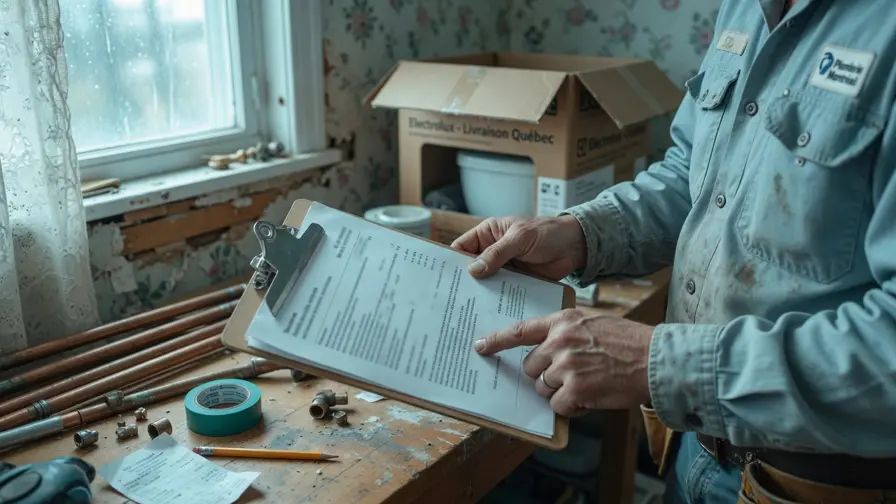
An "ok go" in a text message protects no one.
The client thought demolition was included. You had priced installation only. Nobody acted in bad faith: the work had simply never been written down. That's why a quote isn't paperwork. It's the document that locks the price, the scope, and — most of all — what is not included, before you pick up a tool.
Here's how to write one in Quebec, a template you can copy, and how to turn it into an invoice once it's accepted.
Quote, estimate, contract, invoice: they are not the same thing
In Quebec, clients look for a soumission. "Devis" and "quote" mean the same thing: a price offer, not an invoice yet.
| Document | When | What it does |
|---|---|---|
| Quote (soumission / devis) | Before the work | You propose a price and a scope. The client can accept, decline, or ask for changes. |
| Contract | When the offer is accepted | An accepted offer can become the contract. For some residential work, a more formal written contract is required (see below). |
| Invoice | During or after the work | This is the document Revenu Québec and your client will use for taxes and payment. |
A Quebec invoice has its own required fields. A quote is not a tax document. It does something else: it prevents "I thought that was included."
What a Quebec quote should include
The Office de la protection du consommateur and the Régie du bâtiment du Québec recommend a detailed written document. It isn't a legal requirement in every trade, but it is what gets you out of a dispute. From the sender's side, that means:
You:
- Your legal name (the one on your RBQ licence, if you have one — not a nickname)
- Your full address, not just a cell number
- Your NEQ, if you have one
- Your RBQ licence number, if the work requires it
- Your GST and QST numbers, if you're registered
The job:
- The client's name
- The job-site address, often different from the billing address
- A unique quote number (
QUO-2026-014) - The issue date and an expiry date (15 to 30 days)
- Work included, line by line: quantity, unit price, labour vs materials
- Exclusions (the section that matters most)
- Lump sum or hourly, stated clearly
- Payment terms (deposit, progress draws, balance)
- An estimated start and end date
- How the client accepts (written reply, signature, or an accept link)
If you're tax-registered, show GST (5%) and QST (9.975%) separately, the way you would on an invoice. The client needs to see the real total. You collect those taxes when you invoice or get paid, as explained in how to calculate GST and QST.
A template you can copy
Same layout as our invoice template, on purpose. Once it's accepted, you reuse the lines.
QUOTE #QUO-2026-014
Valid until October 16, 2026

Issued by:
Jean Tremblay — Plumbing
456 Artisans Blvd, Laval QC H7L 2N3
NEQ: 1234567890    RBQ: 5678-1234-00
GST: 123456789 RT0001    QST: 1234567890 TQ0001

For:
Résidences du Lac Inc.
Job site: 12 des Érables St, Laval QC

─────────────────────────────────────
Description                              Amount
─────────────────────────────────────
40-gal water heater replacement
(supply + install)                       $650.00
Labour — 3 h × $85/h                     $255.00
Disposal of the old unit                  $45.00
─────────────────────────────────────
Subtotal                                 $950.00
GST (5%)                                  $47.50
QST (9.975%)                              $94.76
─────────────────────────────────────
TOTAL                                  $1,092.26
─────────────────────────────────────

Included: supply and install of the water heater, connections,
start-up, removal of the old unit.

Excluded: opening/closing walls, painting, municipal permit,
unforeseen work behind walls, travel outside the Island of Laval.

Price: lump sum for the lines above.
Deposit: 30% on acceptance, balance on completion.
Schedule: 1 day, to be booked within 15 days of acceptance.
A quote like this, accepted in writing, is what will later justify the amount on your invoice.
Exclusions: the section that protects you
This is often more important than the logo. If it isn't written down, the client can reasonably believe it's included — and if there's doubt, a contract is interpreted against the person who drafted it.
A typical list for construction and renovation — copy it, then strike what doesn't apply:
- Municipal permits, certificates, inspections
- Opening and closing walls, patching, painting
- Unforeseen work behind walls (rot, asbestos, wiring that's out of code)
- Client-supplied materials, and time lost if they're missing or off-spec
- Equipment rental not listed (scaffold, lift, boom truck)
- Debris disposal, if it isn't its own line
- Travel outside an agreed radius, evenings, weekends, holidays
- Unnamed subcontracting (electrical, drywall, tile)
For a service business (photographer, esthetician, caterer): overtime, a second location, waiting time, late cancellation, photo usage rights. Same logic, less plaster.
If the job changes, you don't improvise an extra on the spot. You send a revised quote, or a short priced write-up, before you do the work. Same idea as in the invoicing mistakes post: no written quote, no safety net.
Lump sum or hourly
Lump sum when the scope is clear: replace a water heater, paint a room with known dimensions, install 12 metres of fence. Clients like it. So do you, if the exclusions are solid. You can't add work the client didn't ask for, or inflate a lump sum because it took you longer.
Hourly when you can't see behind the wall, or the client keeps changing their mind. Write the rate, a minimum (often 1 or 2 hours), and what happens if you go past the estimate: you stop and reconfirm. You don't stack hours in silence.
Don't mix the two on the same line. "Labour lump sum, materials extra" is clear. "Around $2,000, we'll see" is not.
An expiry date, not forever
Fifteen to thirty days is the useful range. Copper, lumber, and appliances move. A quote with no date is a price the client pulls out six months later.
You can add a line such as: "Material prices as of the purchase date." That does not undo a lump sum you already sold. If you committed to $650 for the unit, you eat the difference, or you get a revision accepted before you buy.
How the client accepts (and when it becomes a contract)
From weakest to strongest:
- A "looks good" by text or email — better than nothing, keep it
- The quote signed and dated, sent back as a PDF
- An accept link with a timestamp, no account required
A clearly accepted quote can amount to a contract. That's why exclusions and the total belong on the document, not in a verbal exchange from two nights earlier.
It doesn't always replace a more formal contract. For residential renovation, the OPC advises attaching the quote to the contract. An "Accept" click in an email documents the agreement; it is not an itinerant-merchant contract.
Itinerant merchants: the special case
If you do door-to-door, a mall kiosk, or you sell, install, or repair doors, windows, insulation, roofing, or exterior cladding at the client's home — even at their request — you may be an itinerant merchant under Quebec's Consumer Protection Act.
In that case, a written contract is mandatory, the client has 10 days to cancel at no cost, and you generally may not take a deposit or start the work during that period. A quote PDF with an "Accept" button is not enough: you need the prescribed contract, with the cancellation form.
If you're the electrician the client called themselves, this regime usually doesn't apply. A lot of people think they have 10 days on any quote. The OPC is clear: they don't.
Deposits outside that regime: the OPC suggests keeping them small, billing most of the job against progress, and holding 10 to 15% until the end. Write it on the quote.
From accepted quote to invoice
The day the client says yes, you shouldn't retype the lines. In L'app du travailleur:
- You create the quote with your line items, taxes, a validity date, and your notes (inclusions, exclusions, deposit)
- You send it by email: the client gets a professional PDF and a link to accept, with no account to create
- When they accept, you're notified and the quote moves to approved
- You convert it to an invoice: lines, amounts, client, and reference come with it
Then you send the invoice the day the work ends, not the following week. That's the single step that does the most for getting paid, as we cover in invoicing mistakes. If payment drags, the paper trail — accepted quote + invoice — is what you use, not an April text message.
The Free plan includes 5 quotes a month. Details are on the pricing page.
If you're not in construction
Photographer, massage therapist, hairdresser, caterer, trainer: you don't put an RBQ licence on the PDF, and the itinerant-merchant rules generally don't target you. You still want a quote.
Same document, lighter fields: package or package + extras, date, location, what happens on cancellation, overtime, a second trip. Clients often compare two or three offers. The clear one gets accepted faster, and you invoice exactly what was agreed.
Five expensive mistakes
No exclusions. That's the one that opens disputes. Three lines beat a pretty header.
No expiry date. A June price pulled out in November, on material that went up 18%.
Taxes missing, or stuffed into the total. The client signs $950, then discovers $1,092 on the invoice. Show GST and QST on the quote if you're going to charge them.
Starting on a text message. "Ok go" is not a scope. Send the quote anyway, even if the client is in a hurry, and keep proof of the agreement.
"Around $2,000." With no lines, it isn't a quote. It's an invitation to renegotiate after the fact.
FAQ
Are "soumission" and "devis" the same thing? In Quebec, yes, for a self-employed worker. Clients say soumission. Devis is the more formal synonym. Pick one word on the document and stay consistent.
Is an accepted quote a contract? Often, yes: a clear offer, clearly accepted, can bind both sides. That's why exclusions and the total belong in writing. For some consumer contracts (itinerant merchant, distance contract), the law requires a more formal document. When in doubt, talk to a lawyer.
Do I have to show GST and QST on a quote? If you're registered, yes: the client needs to see the real total. If you're a small supplier under the $30,000 threshold, you don't add the taxes — not on the quote, and not on the invoice.
How long is a quote valid? There's no single legal deadline. Fifteen to thirty days is useful practice. Put the date on the document, or it stays open.
Can I ask for a deposit? Yes, except under the itinerant-merchant rules during the 10-day period. Otherwise keep it reasonable, bill against progress, and write the terms on the quote.
Do I need an RBQ licence to send a quote? To perform or supervise covered construction work, yes. The number should appear on your documents. Check your subcategory in the RBQ licence register. Quoting work you can't legally do doesn't get you far.
Quick reference
| Do this | Why |
|---|---|
| Write the exclusions | That's what cuts disputes |
| Number and date it, with an expiry | Price and proof over time |
| Split GST and QST if you're registered | The client sees the real total |
| Get a written yes before you start | A text is not a scope |
| Convert to an invoice when the job ends | Less retyping, paid faster |
This is not legal advice
The rules above reflect general guidance from the OPC, the RBQ, and the Civil Code of Québec. Your situation can change with the type of work, where the contract is signed, and whether the client is a consumer or a business. For a large renovation contract or an itinerant-merchant case, a lawyer is the right call.
What we can do: draft the quote, send it, keep proof of acceptance, and convert it to an invoice without retyping a line, in L'app du travailleur.
More from the blog

Invoice Template for Self-Employed Contractors in Quebec
A free Excel invoice template and what a Quebec invoice must include: GST/QST, NEQ, RBQ licence, payment terms, late fees, and common mistakes.
Tax-Deductible Expenses for Self-Employed Workers in Quebec: The Complete List
Vehicle, tools, home office, GST/QST: the complete list of tax-deductible expenses for self-employed contractors in Quebec, based on Revenu Québec's rules.

Client Won't Pay: How to Follow Up Without Losing the Client
Overdue invoice, silent client: here's how to follow up effectively (with email templates), what Quebec law says, and how to automate your reminders.

How to Calculate GST and QST in 30 Seconds
As a self-employed contractor in Quebec, you must charge GST (5%) and QST (9.975%) once your revenue passes $30,000. Here's the formula to use.